- Jim Bottorff's
Banjo Page
- TIPS ON LEARNING
TO PLAY THE BANJO

- Return to Songs
- Following are
some tips that might help getting started with the banjo:
- For the purpose
of this Website there are three types of banjos:
- (Click on the
images to enlarge)
-
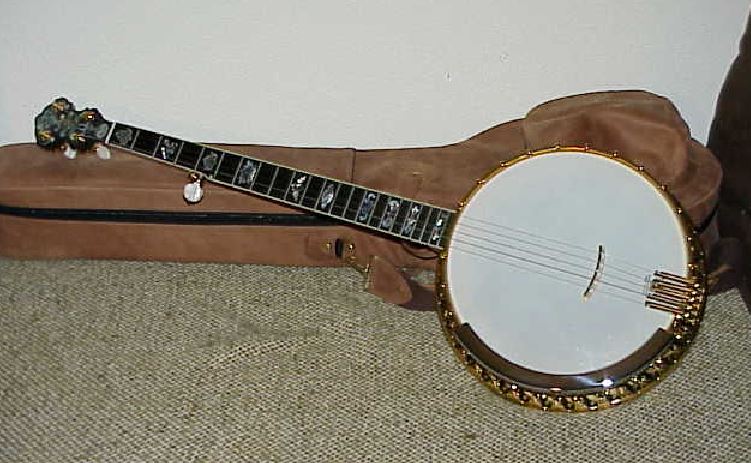
- 5-String Banjo
-
- The 5-String banjo has five
strings and a neck with 22 frets. The 5th string is a short
string on the side of the neck.
- Lots of styles of playing
are used including finger picking and strumming both with and
without finger picks.
- Many different tunings are
used on the 5-string, the three most common are "G"
(gDGBD) "C" (gCGBD) and "D" (a or f#DAF#D).
- The various tunings allow
for more open string chords and easier finger picking.
Capos are used as well for changing keys.
-
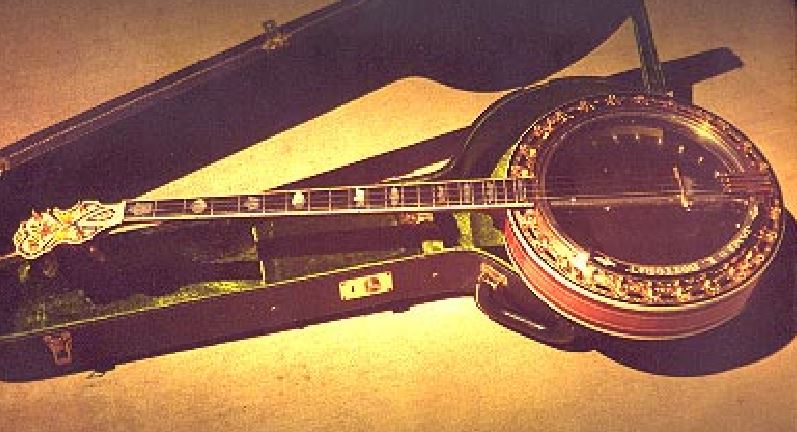
- 4-String Plectrum Banjo
-
- The 4-String Plectrum banjo
has four strings and a neck with 22 frets. Same as a 5-String
banjo without the 5th string.
- Standard tuning is "C"
(CGBD). Other popular tunings include "G" (gDGBD)
and "Guitar" (DGBE).
- The most common styles of
playing include using a flat guitar pick to play single strings
and chords, often along the entire neck.
- Playing in different keys
is accomplished by learning chords for that key. Using
a capo to change keys is not common.
-
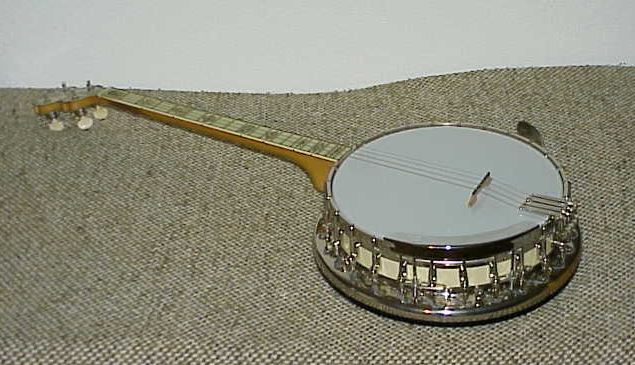
- 4-String Tenor Banjo
-
- The 4-String Tenor banjo
has four strings and a short neck with 19 or 17 frets. The 17
fret banjos are often called "Irish Tenor".
- Standard tuning is "Tenor"
(CGDA). Other popular tunings include "Irish Tenor"
(GDAE), "Plectrum" (CGBD) and "Guitar" (DGBE)
- The most common styles of
playing include using a flat guitar pick to play single strings
and chords, often along the entire neck.
- Playing in different keys
is accomplished by learning chords for that key. Using
a capo to change keys is not common.
-
- Getting Started:
-
- Go to a local music store
and browse through the books on banjo playing, 5-String, Plectrum,
and Tenor. Select
a book for your particular banjo interest that shows tuning methods,
basics of music, chord exercises, and a few songs. The
Mel-Bay company has a large number of beginning and advanced
publications. Harry Reser and Roy Smeck are names to look
for in the older books that can be found on Ebay and other internet
sites. Although they were well known as tenor banjo players,
they wrote books for all types of banjos. Instruction books with
CD recordings are good but not necessary.
-
- If you like folk and bluegrass
music, Pete Seeger's "How to play the 5-string Banjo"
book has a lot of variety with examples of various styles of
strumming and finger-picking. Some banjo books focus on
only one style of playing, such as frailing, 3-finger picking,
single-string melody, or chord-melody. These are good if
you know what playing style you want to learn. If you are not
sure what style you are interested in, stay with the books that
show music basics and simple songs with chord diagrams. Watch
banjo instructors and performers on YouTube to get some knowledge
of the different styles.
-
- Local city and county libraries
sometimes have books and recordings that are no longer available
in the music stores or the internet. You can also access
the Internet from most libraries for reviews of the books you
find. Used book stores may have some banjo instruction books
as well. Internet sources for books, records, videos, and CD's
are "ebay.com" and "amazon.com". Amazon
has reviews of most of the products.
-
- Learn to tune the banjo
by various methods such as, electronic tuner, piano, pitch pipe,
tuning fork, other instruments, and relative-tuning. The
relative-tuning is explained in most beginning books and this
should be one of the first things you learn on the banjo. Always
check the tuning before playing or practicing. Being able
to stay in tune is very important.
-
- Learn the left hand chord
positions for C, F, G7 and then G, C, D7, playing them in the
order shown. Use a flat guitar type pick, your fingers,
or the back of your finger nails, to strum/pick the strings.
Don't be concerned with rhythm or anything else until you
can make each chord sound clear and loud without buzzing or sounding
muted. Practice, practice, practice. As you hold the chord,
strike each string separately to make sure you are getting clean,
clear sounds. Getting a clear sound from each string is
very important.
Once you have learned to tune the banjo easily and make clear
sounding chords, then it's time to continue on with the
various right hand techniques such as flat-picking, frailing,
finger-picking, etc. Rhythm, timing, and speed of changing
chords will come with practice. Keep the right and left hand
techniques separate at first, then combine them together as they
get easier. "Skip To My Lou", "Down In The
Valley", "Camptown Races", and "Buffalo Gals"
are typical of the types of songs to practice. Play chord accompaniment
and then progress to melody techniques.
-
- Listen and watch as many
banjo players as possible. Choose a style(s) of playing
you like. Find a local banjo teacher that can teach you
music basics, rhythm, timing, and some songs.
Have your banjo checked-out and adjusted by someone with banjo
knowledge. Watch while they do it and have them explain
the function of the different parts. Learn about string
gauges and how to change strings. Learn how to properly
adjust the bridge and tighten the head of your banjo. Almost
every part on the banjo has a relationship to the way it sounds.
-
- When you are ready
to start playing along with some songs click here.
Practice every day, very important.
-
- Happy Picking and Strumming,
- Jim Bottorff
- Return to Songs